AI Academic Research Tools
Discover top AI tools that enhance efficiency and accuracy in academic research tasks.

Academic research can often feel like navigating an overwhelming maze of information. With an endless sea of journals, articles, and studies, finding the right resources can be both time-consuming and frustrating. This is where AI tools come in, promising to simplify the research process and enhance productivity.
The landscape of academic research has evolved significantly, and today’s AI tools offer capabilities that go far beyond basic information retrieval. From intelligent literature reviews to data analysis support, these technologies are transforming how researchers gather and synthesize information.
In my quest to uncover the best AI tools for academic research, I spent considerable time experimenting with a variety of platforms. Each one has its unique features, catering to different aspects of the research journey—from organizing notes to generating citations.
As new tools surface regularly, some have already established themselves as indispensable allies for scholars and students alike. Here’s a curated list of the standout AI tools that can elevate your academic research game. Let’s explore what they offer.
The best AI Academic Research Tools
-
46. Talk To Books for efficiently locate relevant book passages.
-
47. Locus for streamline literature reviews efficiently.
-
48. Cebra for exploring latent spaces in neural datasets
-
49. Papers Gpt for streamlined literature review automation
-
50. Wisio.app for consulting recent research for studies.
-
51. Bookabout for access scholarly book recommendations.
-
52. DocXter for streamlined literature review assistant
-
53. Ask A Philosopher for interpreting philosophical theories in research.
-
54. Dobb-E for developing robotic learning algorithms
-
55. TextLayer for streamlined research article exploration.
-
56. Zelma for support educational policy analysis
-
57. Focal for accelerate literature reviews with gpt-4.
-
58. Summarizepaper for condensing complex research for easier access.
-
59. Insight AI for literature review summarization
-
60. Research GOAT for streamlined qualitative data analysis
69 Listings in AI Academic Research Tools Available


Talk To Books cons:
- Talk To Books has been closed down, so it is no longer available for use.
- Talk To Books has shut down and is no longer available for use, which limits its usability and value for individuals looking for an AI tool in the same industry.
Talk To Books is an innovative platform designed to enhance the literary research experience by allowing users to interactively explore ideas and discover books. By simply stating a thought or posing a question, individuals can access curated passages from a diverse range of texts, thanks to advanced AI technology that supports semantic matching and retrieval. Since its launch in 2018, the platform has attracted significant interest for its ability to facilitate meaningful conversations about literature, offering a unique approach to exploring content that traditional search methods may not provide. By engaging millions of users, Talk To Books exemplifies how artificial intelligence can transform academic research into a more interactive and insightful journey, broadening the horizons of literary inquiry.


Locus pros:
- Research faster with AI assistance
- Summarize entire pages or portions to save time and quickly get the TLDR


Cebra pros:
- Non-Linear Embedding Techniques: Leverages advanced non-linear methods to merge behavioral and neural data revealing dynamic neural activity.
- Flexible Application: Suitable for diverse datasets including calcium imaging and electrophysiology and across various sensory and motor tasks.
Cebra cons:
- No cons available in the provided documents.
- No specific cons or missing features of using Cebra were mentioned in the provided documentation.


Papers Gpt pros:
- Vast integration capabilities with various data sources
- Customizable AI, yielding more specific and accurate answers
Papers Gpt cons:
- Requires technical know-how to integrate data sources effectively
- Limited mobile compatibility; best accessed on larger screens


Wisio.app pros:
- AI suggestions for improving writing quality
- Comprehensive database of relevant scientific papers


Bookabout pros:
- BookAbout uses advanced AI technology to search through over 500,000 books for personalized book recommendations.
- BookAbout provides a user-friendly interface for easy browsing, searching, and exploration of books.


DocXter pros:
- Supports language simplification
- Can provide chat history
DocXter cons:
- Limited file format support
- No mobile application
DocXter is an innovative AI-driven platform tailored for academic research and document analysis. This interactive tool is engineered to help users extract meaningful insights from a wide array of document types, including DOC, DOCX, PDF, PPTX, and TXT files. By leveraging advanced AI technology, DocXter enhances the research experience through features like real-time collaboration, personalized study guidance, and in-depth analysis support aimed at students and professionals alike. Its ability to decode complex documents and identify key information streamlines the study process, making it an invaluable resource for anyone engaged in academic pursuits. With versatile AI models at its core, DocXter empowers users to interact with documents in precise and effective ways, significantly enriching the research journey.


Ask A Philosopher pros:
- Advanced AI Philosophy: Leverages sophisticated AI to simulate discussions with a philosopher.
- Diverse Philosophical Perspectives: Offers insights across different schools of thought.


Dobb-E pros:
- Dobb·E leverages a tool called the Stick for data collection
- Provides access to pre-trained models, code, and documentation through GitHub
Dobb-E cons:
- Dobb·E does not provide any specific cons in the information available.
- The cons of using Dobb·E are not explicitly mentioned in the provided documents.


TextLayer pros:
- Implementation Support: Get step-by-step guidance from GPT-4 to apply AI research effectively.
- Flexible Pricing: Choose from various subscription plans tailored to your research journey.
TextLayer cons:
- No specific cons or missing features of Textlayer were found in the provided documents.
- No cons or disadvantages of using Textlayer were mentioned in the provided documents.


Zelma pros:
- Specializes in U.S school data
- Enabled plain language queries
Zelma cons:
- No API for integration
- Limited to U.S. data

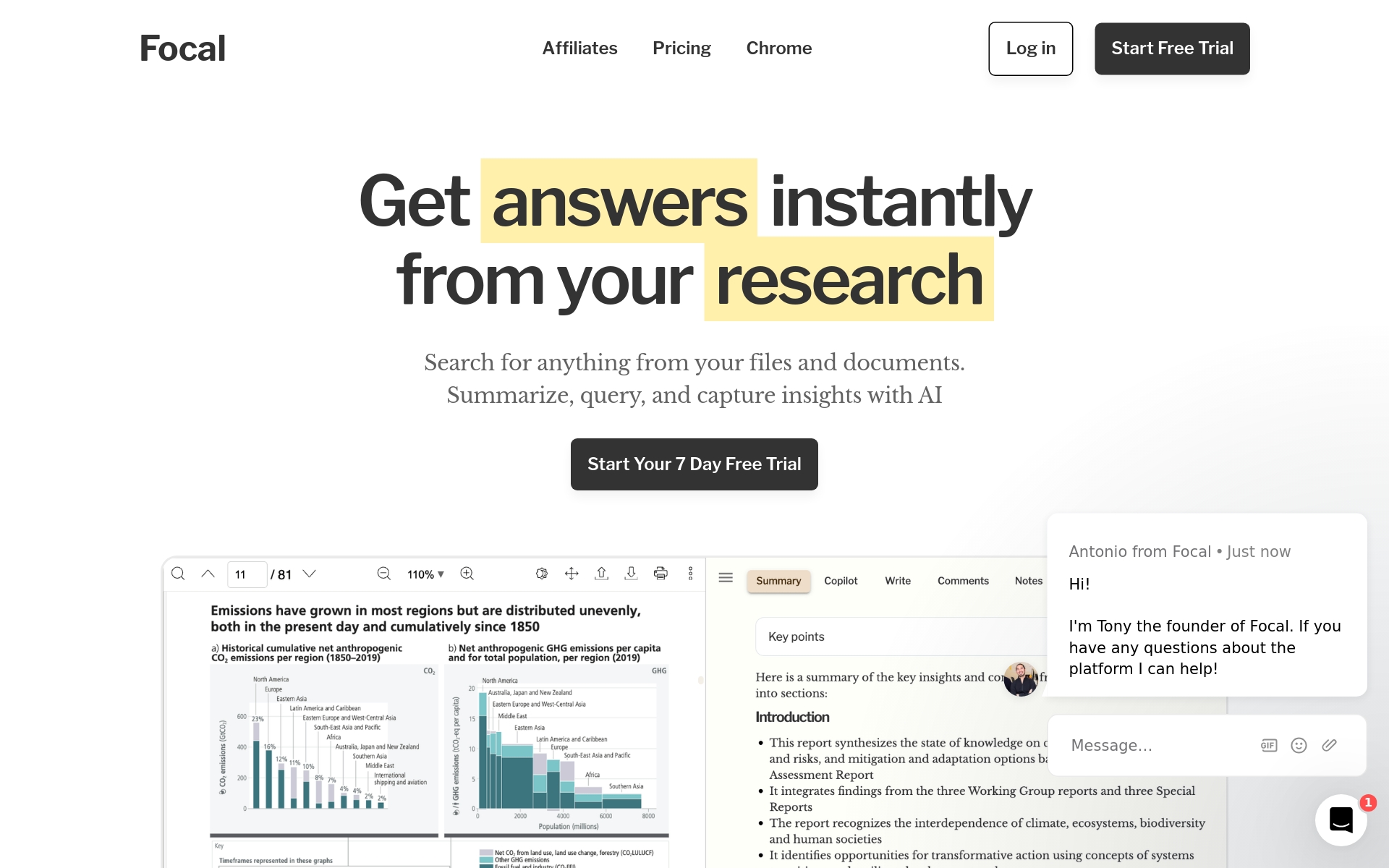
Focal pros:
- AI-embedded: Work alongside AI to enhance your research workflow with GPT-4.
- Save Forever: Securely save web pages and PDF documents indefinitely.
Focal cons:
- Currently only supports desktop, no mobile app available
- No free plan, limited trial before subscription
Focal Pricing
Paid plans start at $USD/month and include:
- 2,000 pages per month
- Standard AI Model
- PDFs and Web Articles
- AI Summaries
- AI Copilot Sources
- AI Copilot Workspace


Summarizepaper pros:
- SummarizePaper.com provides concise and understandable summaries of arXiv research articles
- User-friendly search feature with the ability to search by keywords, arXiv IDs, and authors
Summarizepaper cons:
- The AI-based summarization tool and virtual assistant provided on this website may not always provide accurate and complete summaries or responses
- Unclear information on data security measures


Insight AI pros:
- My Variant feature integrates more than 400 million human variants.
- MyGene feature integrates more than 22 million genes for more than 22 thousand species.


Research GOAT pros:
- In-depth qualitative research
- Transforms questions into understanding
Research GOAT cons:
- Limited trial availability
- No iOS or Android app
Research GOAT is an innovative platform that streamlines the process of qualitative research by leveraging artificial intelligence to conduct interviews autonomously. Designed specifically for academic researchers, it transforms complex questions into actionable insights swiftly and efficiently. The AI-driven moderators engage participants in dynamic discussions, allowing for a thorough analysis of responses without the need for human oversight.
This tool stands out not only for its cost efficiency but also for its flexibility, enabling researchers to customize their studies and connect with participants across diverse geographical locations. Furthermore, Research GOAT integrates seamlessly with social media networks, enhancing its accessibility and reach. The platform offers a free trial and a variety of subscription plans to accommodate different research teams' needs, making it a valuable resource for academics seeking to enhance their research capabilities.
Related Categories
- Academic Research Tools
- Academic Writing Tools
- AI Detectors
- Assignment Tools
- Chemistry Tools
- Citation Tools
- College Students Tools
- Essay Writing Tools
- Graduate Students Tools
- Grammar Checkers
- Language Learning Tools
- Law Students Tools
- Lesson Planning Tools
- Mathematics Tools
- Medical Students Tools
- Paraphrasing Tools
- PDF Chat Tools
- Plagiarism Checkers
- Report Writing Tools
- School Tools
- Science Tools
- Students Tools
- Summarizers
- Teachers Tools
- University Students Tools